

Chancellor Darrell T. Allison
A Strategic Educational Executive, Achieving Transformational

Change in Higher Education
Darrell T. Allison is the 12th chancellor and chief executive officer of Fayetteville State University (FSU), the second oldest public institution in the University of North Carolina System.
March 15, 2026, marked his 5th year as Chancellor at the University and his unwavering commitment to advancing the University’s academic mission, while building on opportunities to strengthen community partnerships. During his tenure, he helped secure $200 million in capital projects from the NC General Assembly and is responsible for the more than $500 million total funding support from research, grants, and private donations.
Throughout his tenure at FSU, Chancellor Allison’s visionary leadership has catalyzed widespread institutional renewal, yielding unprecedented success in the core areas of:
- Student success and career preparation
- Service to military-affiliated students
- Regional economic empowerment and development
- Major funding acquisition and fundraising
- Athletic competition.
His tangible impact at FSU has caught the attention of state influencers, earning him a spot on Business North Carolina’s “Power List” in Education for four consecutive years, in 2022, 2023, 2024 and 2025.
Today, FSU has witnessed its highest student retention rate percentages; record levels of alumni giving percentages; highest enrollment numbers – eclipsing 7,600 students for the first time in history (2025) and historic levels of construction and expansion at any time in the 158 years of the university’s history.
Student Success and Career Preparation
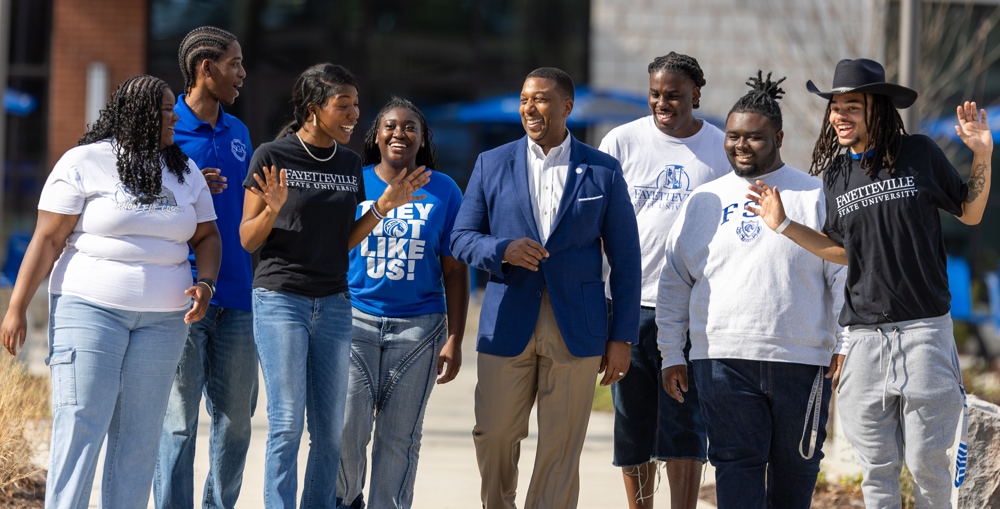
Under the leadership of Chancellor Allison, Fayetteville State University has been able to achieve growth in enrollment, retention rates, and 4-year graduation rates that are among the highest rates of growth and improvement in the UNC System (16 Systems institutions total). In achieving record enrollment of over 7,600 students in the Fall of 2025, the University had the highest enrollment growth of any UNC institution, at 7.3%, and has been one of the few UNC institutions that have seen consistent growth in each of the last four years. Retention rates for incoming freshman improved from 63% for the class which entered the Fall of 2020 just prior to the Chancellor’s arrival (lowest rate of retention in the UNC system) to 78% for the class which entered the Fall of 2024 (above average among comparable UNC institutions). 4-year graduation rates are also on a rapid improvement trajectory, increasing from 19% for the class which entered in 2020, prior to his arrival, to nearly 25% for the class which entered in 2021. This improvement of 5+ percentage points in graduation rates was the highest annual rate of improvement of any UNC System campus. The University is on track to continue to enhance student success in the classroom and beyond.
New approaches were needed to help students achieve at their potential because the University serves a higher proportion of students from low resource communities than any other UNC System institution, with 80% of the University’s in-state students coming from counties designated by the State of North Carolina as among the most economically challenged in the state (Tier 1 and Tier 2 counties). Moreover, it was recognized that with 46% of students being 25 years of age or older, FSU has among the highest proportion of adult learners in the UNC System (compared to a system average of 24% adult learners), with most having significant work and family commitments.
To help address the unique challenges of the broad range of students served by Fayetteville State University, the following key strategic student success initiatives were launched:
- 30-60-90 Campaign encouraging students to stay on track for 4-year graduation, featuring free summer school for up to 7 credits, including room/board and food plan where needed, funded by FSU.
- Established a 20-community college partnership, called Bronco Benefit that makes it easier for students to transfer credits to FSU.
- Established a free Bronco Boost immersive summer transition program for incoming students, offering introductory core courses, extracurricular activities, and academic advising (successful students starting day 1 of Fall with a total of 7 core credit courses already completed)
- Doubling the number of academic advisors and increasing access to tutors (16-32)
- Repurposing the functionality of the library to include Bronco One-Stop – centralized student support services in a readily accessible easy to navigate location
- Free laptops provided to all incoming freshmen (2024-2027), in collaboration with Lenovo Corporation – a multi-million-dollar investment.
- Launched and significantly funded Bronco Helping Broncos Student Emergency Fund, an anti-stop out and drop out student program that provides resources for students who are experiencing emergencies and need assistance.
These initiatives and more are expected to drive continued improvement in enrollment, retention and 4-year graduation rates. The University is projecting continued growth enrollment to 8,000 students by Fall 2026-27, despite demographic headwinds reducing the number of students entering college from high school. The University is also on track to continue rapid improvement in 4-year graduation rates for the uniquely broad base of students served, expecting soon to exceed the 30% average graduation rate among the state’s public HBCUs.
Additionally, to help maximize economic mobility for the students served and to support regional economic development, Chancellor Allison has been a champion of market-responsive excellence in the academic programs offered. To address critical workforce needs he has worked closely with academic and community leaders to introduce six (6) new undergraduate degree programs and one graduate program over the 2021-2025 period. These include:
- Cybersecurity: one of FSU’s fastest-growing majors filling a critical national need.
- Supply Chain Management and Technology: where FSU is a national leader in instruction around the key SAP supply chain technology platform used by most major corporations and by the U.S. military (including one of only 13 SAP NextGen Labs in the nation).
- Materials Science and Manufacturing: preparing students to contribute to high demand fields associated with advanced manufacturing.
- Sport and Fitness Management: another fast-growing major opening a broad range of students to highly impactful career paths contributing to the health and wellbeing of an historically under-resourced region.
- Construction Project Management: introduced in response to demand from a growing regional construction industry and in close collaboration with a regional community college.
- Public Health: an impactful new degree program serving to help fill public health gaps.
Existing programs continue to earn accolades as well. For example, FSU’s nursing program has been ranked by US News and World Report as the best HBCU Nursing program in the state of North Carolina; moreover, FSU’s BSN nursing program is ranked #1 of all state universities. FSU’s online MBA program has been ranked by US News and World Report as among the top two HBCU programs in the nation. The University's Forensic Science Program is ranked as the #2 program in the nation among Forensic Biology Degree programs.
Student Career Preparation:
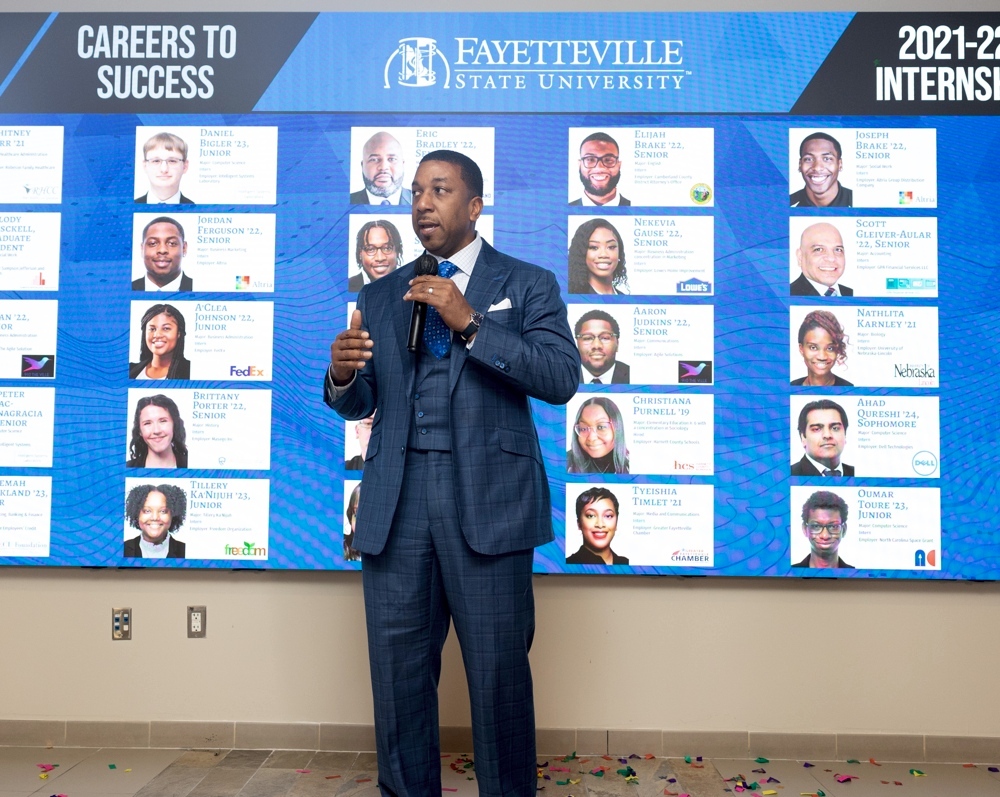
To help prepare students for successful career options after graduation, Chancellor Allison launched a paid internship initiative, as employers regularly report that internship experience is one of the most impactful ways that students can improve their competitive position and readiness for professional opportunities. Through this initiative internships were offered through partnerships with corporate employers providing academic credit as well as the financial compensation so critical to so many of FSU’s students. The initiative:
- Set cumulative goal of 750 paid internships 2021-2024 from base of 50 in 2020 prior to arrival, with a target of working with 100 employers.
- Achieved nearly 1,600 paid internships, paying nearly $8 million in total compensation to FSU student interns, working with over 235 corporations and agencies to date.
Service to military-affiliated students
Utilizing a highly targeted approach to student outreach and support, Chancellor Allison has substantially broadened FSU’s impact with military-affiliated students, Increased staffing was put in place to support the unique needs of students using military-benefits and increased focus placed on enabling those with military backgrounds to earn academic credit for equivalent military training.
To further support the military community, Chancellor Allison launched an innovative program in 2022 to provide free tuition to all military-affiliated students (veterans, reservists, active-duty, spouse of military and dependents of military), spurring dramatic enrollment increase. As a result, FSU’s military student population has grown 27% since initiative launch, and FSU is proud to have the largest percentage of military-affiliated students in the UNC System, representing nearly 34% of its 7,600 total student population.
In recognition of the support provided to the military-affiliated community, Chancellor Allison was named an William Pearson Tolley Champion for Veterans in Higher education award winner by Student Veterans of America (SVA), and FSU has obtained recognition from the Military Order of the Purple Heart, designating FSU a “Purple Heart University” for the institution’s support of veterans and families, and is the first of 16 UNC System institutions to receive this honor. The University is perennially awarded the Gold Status for being one our nation’s Military Friendly Schools.
FSU has also received funding from the NC General Assembly to establish a new, full-service military academic center on campus. The more than 22,000 + square foot center will house all military-related offices and provide office space for high-ranking military officials visiting FSU’s campus. It is also set to feature an academic support center for military-affiliated students and veterans and serves as a primary location for instruction, training, and events, as well as two ROTC detachments (U.S. Army and U.S. Air Force).
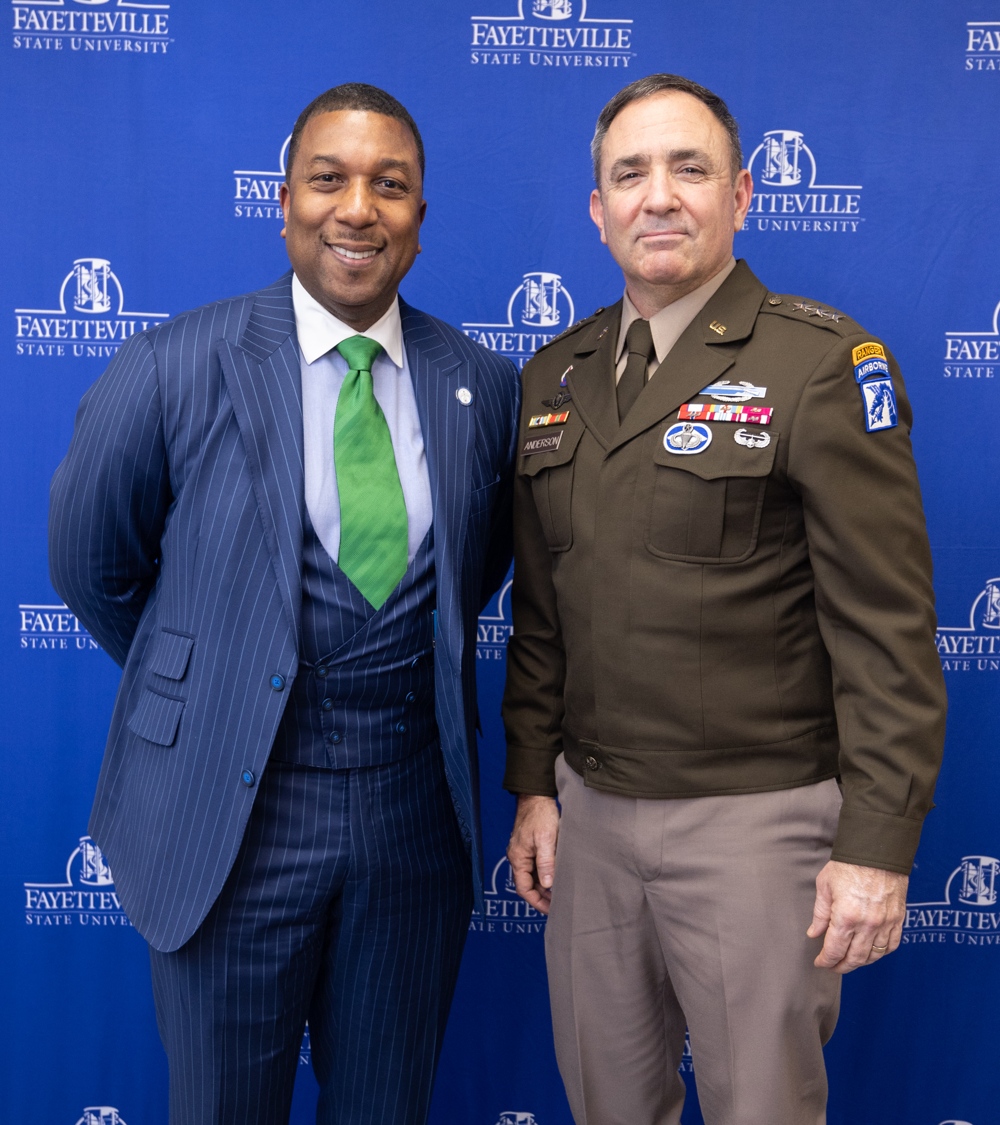
In February 2025, FSU became the first public university to sign an educational partnership agreement with XVIII Airborne at Fort Bragg, in Fayetteville, NC. Facilitated by Chancellor Allison and the first of its kind, the agreement creates a foundation for FSU to provide worldwide training and applied research support for the 80,000-person unit known as the innovation leader for the US Army.
Economic empowerment and development
From his earliest days at FSU, Chancellor Allison has cast an expansive and aspirational vision for the university’s role in fostering regional economic empowerment and development. This vision has inspired the creation of vital partnerships and targeted investment in the local economy. He negotiated the $5 million, 100% debt-free acquisition of Bronco Square, now known as Bronco Midtown, to serve as the site of a transformative economic empowerment initiative for the community and region. Previously, FSU had maintained a 50% partnership in Bronco Square.

This work was leveraged to bring flagship restaurant brands to the university and region, adding to a McAllister’s Deli previously located at Bronco Midtown--driving new employment and revenue opportunities. Under his leadership and guidance, Bronco Development Corporation opened a new Chick-fil-A restaurant in 2024 at Bronco Midtown and a new Starbucks near the center of campus in 2025, each generating new diversified revenue streams for university support of students.
Chancellor Allison also established the Fayetteville-Cumberland Regional Entrepreneur and Business Hub, a partnership between FSU, the City of Fayetteville, and Cumberland County, located at Bronco Midtown. The “HUB” provides free services—such as help securing certifications and start-up capital—to local entrepreneurs and small businesses. Since launch in September 2022, the HUB has:
- More than 230 new businesses have been launched
- Helped small local businesses create or retain nearly 1,000 jobs
- Entrepreneurs and small to mid-level businesses have won over $ 150 million in state and local government contracts
FSU is currently in the process of a major collaboration with the City of Fayetteville and Cumberland County to create new mixed-use development on 20 acres of currently vacant land located downtown Fayetteville and just 0.4 miles from FSU to include student housing, retail, and an innovative farmers market.
Major funding acquisition and fundraising
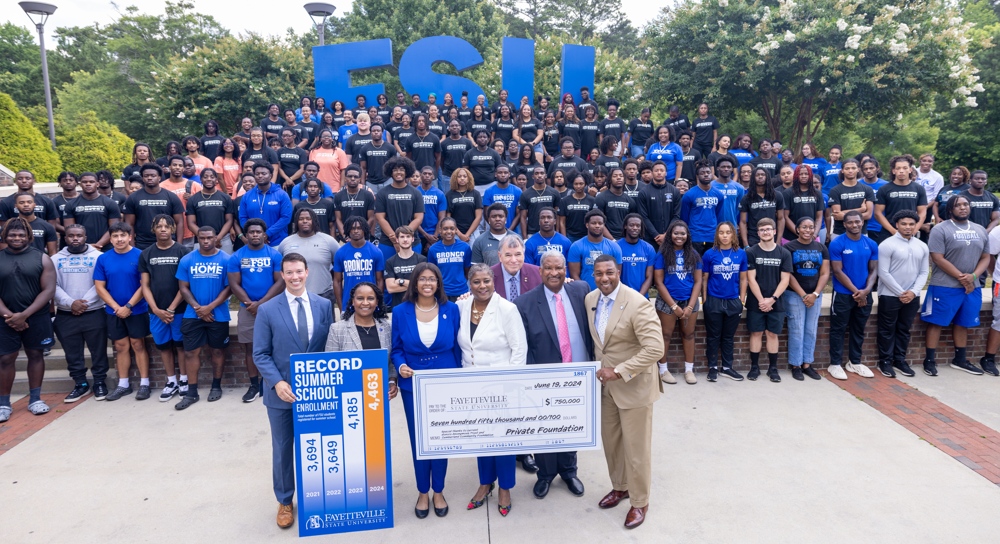
Prior to Chancellor Allison’s arrival, FSU ranked near the bottom among UNC System institutions in state appropriations revenue as well as equipment and capital expenditures; in fundraising, FSU ranked last. Chancellor Allison has altered those trajectories in fundamental ways, pursuing an ambitious approach to major funding acquisition and fundraising that has been historic in its impact. He has secured historic state budget appropriations of over $210 million for FSU capital expenditure requirements. This amount is represents the largest capital appropriation in the history of the University.
He successfully advocated for FSU’s participation as one of four (4) institutions in the state-funded NC Promise Tuition Plan enabling the University to offer full-time tuition at $500 per semester for in-state students and $3,500 per semester for out-of-state students. During his tenure, Chancellor Allison has leveraged more than $210 million in capital projects from the NC General Assembly upon his arrival and is now responsible for the more than $500 million total funding support from research, grants, and private donations for Fayetteville State University to date.
Chancellor Allison helped set fundraising records for contributions from major donors and alumni; raised alumni participation rates from 2.5% FY 2020 (lowest among all Systems schools and prior to arrival) to now an Alumni historic participation record rate of 7.4% in FY2025. FSU major new donors during his tenure period have included Anonymous Trust ($9 million), Cape Fear Valley Health System ($3 million), Thurgood Marshall College Fund (Lilly Foundation) ($2 million), William R. Kenan, Jr. Charitable Trust ($1.4 million), and National Institute of Student Success ($1.1 million), to name a few.
The Cape Fear Valley Health System’s contribution, which included the renaming of FSU’s School of Nursing to Cape Fear Valley School of Nursing building, was particularly momentous. This represented not only financial support for the University but also marked the launch of a major partnership through which Cape Fear will provide resources and classroom space on its campus for FSU nursing students, enabling FSU to double its number of student nurses to 300 by 2027-28. The partnership will do much to help to solve a continuing acute shortage of nurses in the greater Sandhills region.
In total, gifts from private donors and alumni exceeded $25 million over the FY22-FY25 period. In addition, the University competed successfully for multiple major federal grant awards to enhance University capabilities, including:
- $10 million Dept. of Education award to enhance graduate education in targeted high demand disciplines
- $4.9 million Dept. of Commerce award to strengthen broadband capabilities at FSU and in the community
- $4.5 million in two National Science Foundation awards to promote student success and retention in science, technology, engineering, and mathematics disciplines
Enhanced Campus Infrastructure
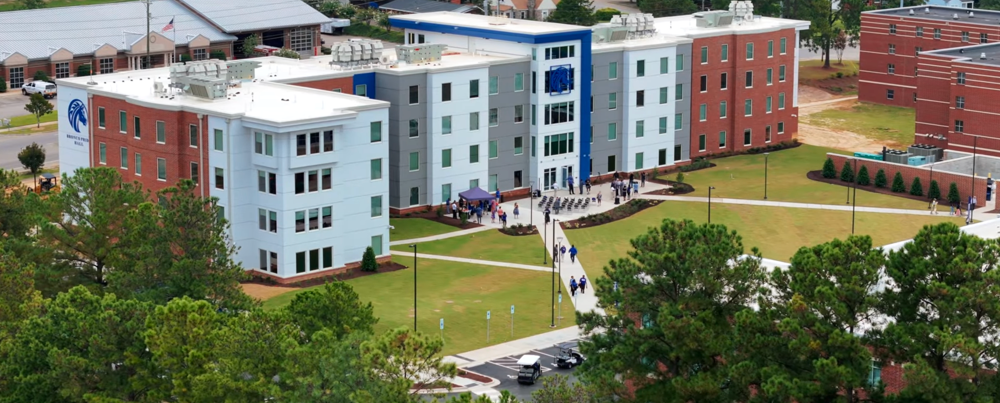
Fayetteville State University having some of the greatest campus needs of repairs and renovations of all 16 schools within the UNC System, Chancellor Allison led the creation of a 10-year Campus Master Plan to guide the physical development of the University, incorporating extensive stakeholder input to address identified needs, accommodate continued growth, and create an attractive environment promoting learning, research, and engagement. He also provided leadership and guidance in the design and construction of major new additions to the campus infrastructure, navigating significant inflationary cost pressures in the face of fixed budget allocations, with new additions including:
- $50 million Bronco Pride Residence Hall, adding 336 beds and totaling almost 90,000 sq. ft., opened for occupancy Fall 2025
- $69 million College of Education building, totaling over 70,000 sq. ft., on track to be completed Summer 2026 on time and on budget
- $14 million Health and Wellness Center, totaling almost 22,000 sq. ft and making possible the expansion of space dedicated to mental wellness and enabling the creation of a new pharmacy for enhanced student access to needed medications, scheduled for completion March 2026
- $11 million 3-level, 288 space parking deck, scheduled for completion July 2026
- $11 million repurpose of the stately Cook Building, the oldest building on campus, which will serve as a new stand-along Military and Veterans Academic Center scheduled for completion Spring 2027
- Opened the newly renovated Campus Aquatic Center in 2023—the product of a $700,000 institutional investment—serving students, other high school and university constituents, and the broader local community.
Building and Fortifying a Research Future
In 2025, Fayetteville State University received recognition as a Carnegie designation Research University. Under his leadership, the University more than doubled federal and state grant awards for research and programmatic support, from $15 million in the 2020-21 academic year to $46 million as reported Fall 2025. With this new designation and research momentum, FSU is on track to reach R2 designation (High Spending and Doctorate Production) further expanding grant opportunities.
In addition, FSU was selected as one of the prestigious seven UNC System institutions to serve as a regional hub for NCInnovation, a non-profit funded with a $500 million endowment from the State of North Carolina to support the commercialization of university-led research (earning distinction of serving as NCInnovation’s Defense Innovation Hub for the state). This opportunity provides FSU focused support for several ground-breaking innovations created by faculty across multiple disciplines with potential to generate multi-million-dollar licensing revenue streams.
Given the momentum both in terms of research dollars and partnership, Chancellor Allison recently relaunched the FSU Research Corporation, which is now on track to drive significant new revenue generation through applied research and training contracts for military, intelligence agencies, and major corporations.
FSU Athletic Program & Accomplishments
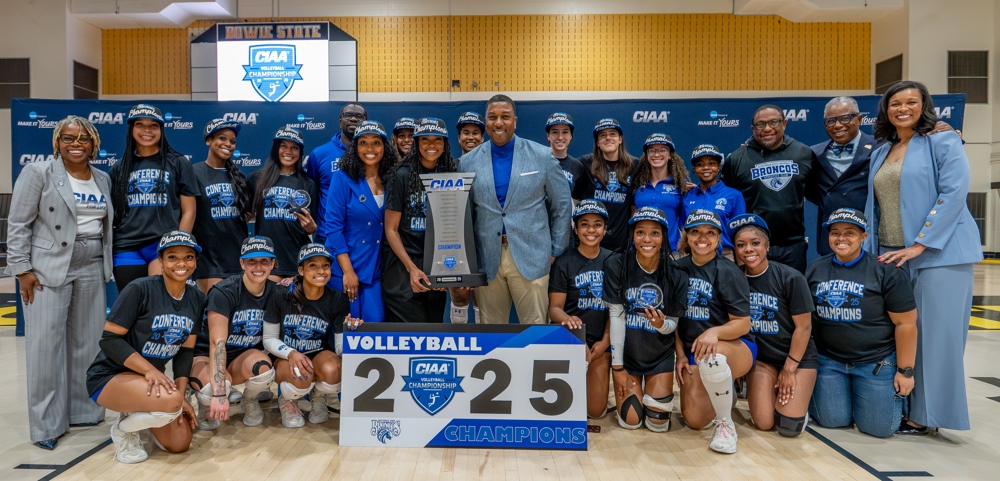
Chancellor Allison not only wants FSU students to compete and be champions in the classroom, but he is also a huge supporter of student-athletes and the FSU Athletic program. He strongly believes that successful athletic programs can strategically elevate and propel the brand and name of a university like no other. Thus, Chancellor Allison is proud of the fact that since the beginning of his tenure in 2021, Fayetteville State University (Bronco Nation) has won 27 championships:
- 2026 CIAA Conference Champions – Men’s Basketball
- 2026 CIAA Conference Champions – Women’s Indoor Track
- 2025 CIAA Conference Champions – Women’s Volleyball
- 2025 CIAA Conference Champions—Men’s Cross Country
- 2025 CIAA Conference Champions—Women’s Cross Country
- 2025 CIAA Conference Champions—Women’s Bowling
- 2025 CIAA Conference Champions—Women’s Basketball
- 2025 CIAA Conference Champions—Women’s Indoor Track
- 2024 CIAA Conference Champions—Women’s Basketball (National Rank #16)
- 2024 CIAA Conference Champions—Women’s Cross Country
- 2024 CIAA Conference Champions—Women’s Bowling
- 2024 CIAA Conference Champions—Women’s Outdoor Track
- 2024 CIAA Conference Champions—Women’s Indoor Track
- 2023 CIAA Conference Champions—Men’s Cross Country
- 2023 CIAA Conference Champions—Women’s Cross Country
- 2023 CIAA Conference Champions—Women’s Outdoor Track
- 2023 CIAA Conference Champions—Men’s Golf
- 2023 CIAA Conference Champions—Women’s Bowling
- 2023 CIAA Conference Champions—Women’s Indoor Track
- 2022 CIAA Conference Champions—Football
- 2022 CIAA Conference Champions—Women’s Cross Country
- 2022 CIAA Conference Champions—Men’s Cross Country
- 2022 CIAA Conference Champions—Women’s Outdoor Track
- 2022 CIAA Conference Champions—Men’s Basketball (first in 50 Years)
- 2022 CIAA Conference Champions—Women’s Indoor Track
- 2021 CIAA Conference Champions—Women’s Cross Country
- 2021 CIAA Conference Champions—Women’s Volleyball
Accomplishments & Awards
- Business North Carolina’s “Power List” in Education, 2022, 2023,2024 and 2025
- Airborne Ambassador Designation, awarded by Commanding General, XVIII Airborne, 2025
- Named to Carnegie Electives Presidents Advisory Council, American Council on Education, 2023
- Named the William Pearson Tolley Champion for Veterans in Higher Education by Student Veterans of America, 2022