

FSU’s Geospatial and GEOINT Programs Contribute to National Dialogue on Future National Security Workforce at GEOHuntsville 2026
Students and faculty connect classroom learning with real-world geospatial and security challenges at a national summit, building direct links with industry and intelligence leaders.
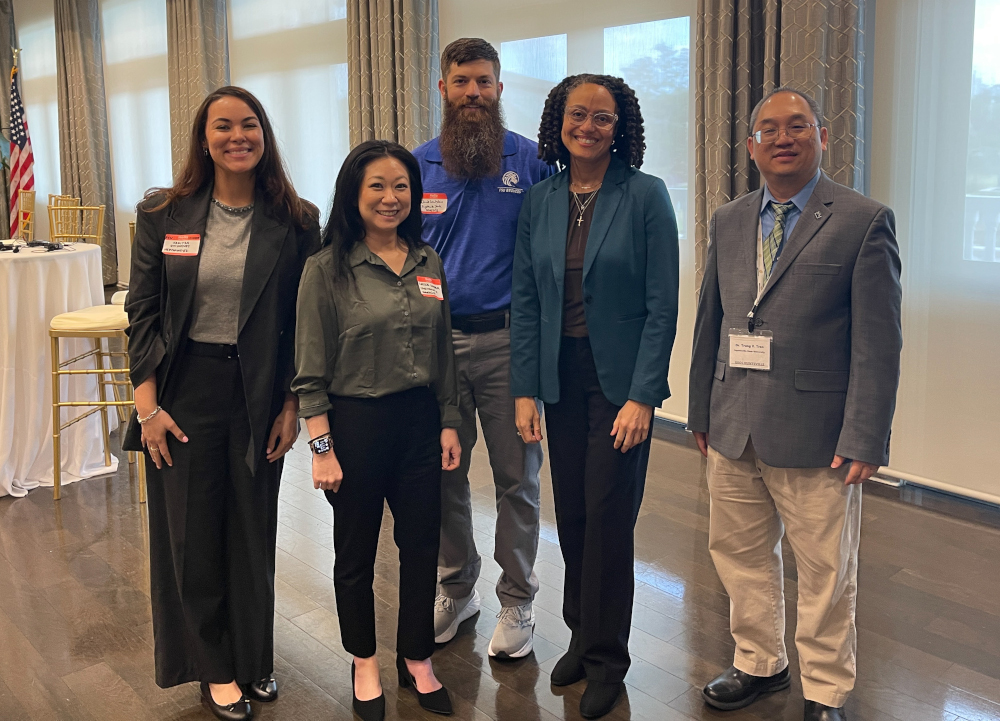 From left, Fayetteville State University student Jaritza Quinones Hernandez, Chelsie Luttrell, Jacob Windstein, Stacey Dixon, Ph.D., and Trung Tran, Ph.D., during the 2026 GEOHuntsville Summit on March 26 in Huntsville, Alabama.
HUNTSVILLE, Ala.– As artificial intelligence and geospatial technologies reshape national security, universities must prepare a workforce to navigate this shift. At Fayetteville State University, that preparation is taking center stage in national conversations about the field's future.
On March 26, FSU faculty and students participated in the 2026 GEOHuntsville Summit at the Huntsville Botanical Garden, themed Rocket City Rising. The event brought together leaders from government, industry, and academia to discuss how emerging technologies are transforming the workforce and shaping the skills future professionals need.
Representing the university was Trung Tran, Ph.D., associate professor of geospatial science and program coordinator of the university’s Geospatial Science and United States Geospatial Intelligence Foundation (USGIF)-accredited geospatial intelligence (GEOINT) programs. Tran joined national experts on a panel titled "Preparing Students for the 2035 National Security Workforce," moderated by Stacey A. Dixon, Ph.D., former acting director of national intelligence.
During the discussion, Tran emphasized that preparing students for the future workforce requires more than technical proficiency.
"We focus on preparing students with workforce-ready skills," Tran said, highlighting the importance of integrating real-world insights into the classroom.
The discussion centered on AI's impact on geospatial intelligence and national security. As routine tasks are automated, Tran stressed the need to develop irreplaceable competencies such as critical thinking, spatial reasoning, ethical decision-making, and effective communication.
For FSU students in attendance, the summit provided a clear link between their education and the field's demands, helping them understand how classroom learning translates into professional opportunities.
“I had a great time at the GeoHuntsville Summit learning how Earth-based sensors and AI support national security in space, while human judgment remains essential in decision-making,” said Jacob Windstein, a senior majoring in geospatial science with a concentration in geospatial intelligence.
Windstein noted the discussion on AI was especially impactful, particularly about balancing efficiency and oversight.
“AI can help speed up our workflows, but there still needs to be checks and balances in place,” he said. “It will take a knowledgeable person to make the final decision.”
For other students, the summit represented more than just learning; it marked a shift from theoretical study to active, professional engagement in the geospatial field.
Geospatial science junior Jaritza Quiñones Hernández used the summit to bridge the gap between students and industry professionals. She navigated the national security community by focusing on the quality of her interactions.
“When connecting with CEOs and other professionals, I tried to stay genuine by being myself rather than focusing on their titles,” she said. “I showed real interest and practiced active listening so I could respond with intention.”
The insights and connections from Huntsville are just another example of the real-world challenges FSU students are tackling through applied collaboration and research at the university, where they are actively developing solutions.
With geospatial intelligence increasingly central to national security, FSU students are positioned to make an immediate and lasting impact as future leaders and problem-solvers, ready to meet the field’s evolving demands.