

FSU’s Partnership with XVIII Airborne Corps Drives Professor’s New Phase of AI Research Backed by NCInnovation
Funding supports artificial intelligence tools for battlefield analysis and broader multi-sector applications.
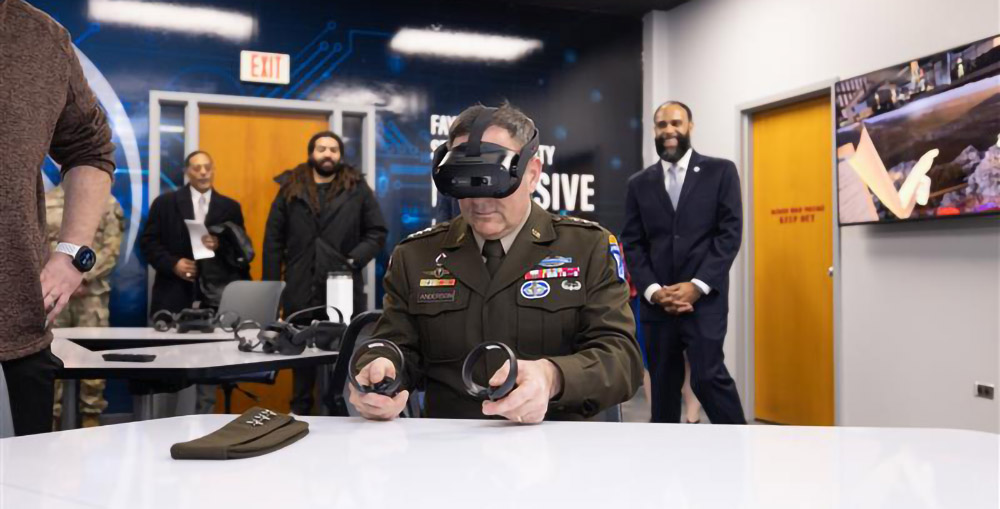
FAYETTEVILLE, N.C. – FSU computer science professor Sambit Bhattacharya, PhD, received a $750,000 award to develop artificial intelligence tools for battle damage assessment for the U.S. Army’s XVIII Airborne Corps at Fort Bragg, with the potential to adapt these tools for broader applications, such as maritime anomaly detection, healthcare, and emergency response. Through this award, Bhattacharya will use a physics-based simulation platform to generate highly realistic images across a wide variety of specified conditions needed to train XVIII Airborne AI models more effectively. This AI project is one of 13 research projects across 11 institutions in the University of North Carolina system that were included in NCInnovation’s December 8th funding announcement. The NCInnovation Board approved a total investment of $10 million in this funding cycle for projects with high potential to generate new products and new jobs.
“Fayetteville State University takes seriously its responsibility to apply the leading-edge research of our faculty to help solve real-world challenges impacting the region it serves,” stated FSU Chancellor Darrell T. Allison. “I am particularly excited about this latest opportunity to respond to challenges brought to us by technology leaders at XVIII Airborne to help improve their AI-enabled battlefield assessment models. This collaboration represents one example of a much broader array of support we expect to provide XVIII Airborne following the Education Partnership Agreement FSU signed with them in February of this year. I am also excited that others are recognizing what Fayetteville State University faculty truly have much to offer – with nearly $2 million of investment in 2025 alone from NCInnovation, as our FSU biology professor, Dr. Shirley Chao, earlier this year was awarded $1.1 million to help bring to market the non-toxic agricultural pesticide."
Led by Bhattacharya, director of FSU’s Intelligent Systems Laboratory, the AI research team will create synthetic-imagery tools to train AI systems and support data interpretation when real-world data is limited or sensitive. In addition to working with XVIII Airborne innovation leaders, Bhattacharya will collaborate with researchers at UNC Hospitals to leverage this technology to improve the assessment of cancer’s impact on individual patients, enabling more effective treatment plans. The project will support broader regional growth by expanding research, developing workforce skills, and connecting local students to careers in emerging technology fields.
"NCInnovation's support builds on applied research at the Intelligent Systems Laboratory that is directly aligned with the mission priorities of defense and security agencies, as well as NASA's space exploration goals," said Bhattacharya. "This investment allows us to accelerate work on challenges critical to both military and civilian applications—questions that require significant resources but offer major benefits for the region and nation. It gives us the ability to create real deliverables and prototypes that would not be possible otherwise. We appreciate the investment and the confidence it reflects in the direction of this work."
Fayetteville State University is prioritizing applied innovation, translating research excellence into strategic impact for the region, state, and nation. With support from partners like NCInnovation and the military, FSU is addressing critical challenges, empowering students, and expanding opportunities that will shape the future of North Carolina and beyond.